Print in Kettering ...
 My first job was at V.B. Pike Printers. The named-owner had recently passed and his assistant had taken over the business - which was situated in a small warehouse (or large barn) at the back of the former's house. The late man's wife used to bring us tea in the mornings, to which we all had to gratefully chirp "thank you Mrs Pike". The new boss, who took me on, was called Cliff Attwood. He wasn't a bad fella, but definitely had ideas above his station and a drive to better himself that could be ruthless. He would kowtow to the masons who came to collect their masonic meetings literature, which he happily printed at cut price (old man Pike had apparently blackballed him from one lodge, but once he had passed, Cliff made sure he got straight into another) - but went to lengths to ensure everyone knew he was the boss and they should know their place. He would have looked out of place in a Dickens novel, but his demeanour and mannerisms could have fit the bill.
 One chap who worked there, Roy Cox, was a really wild character. Married with kids, a short fella with big bushy beard and an extremely wicked and sharp sense of humour. When they cleaned the ink off the rollers of the old printing presses, they used rags from the local yard down the road (Plaistere & Hangers) - which usually came in the form of old clothes they couldn't sell to third world countries. Roy's favourite trick was to find a dress his size, then put it on over his work clothes and appear from behind the large Heidelberg cylinder he was running in steel boots, work trousers, a white dress sporting pink and yellow flowers ... all topped off by his shaggy hair and beard - and a fag hanging out of his mouth.
We'd all piss ourselves laughing, but all you could hear from Cliff was the occasional "oh my Lord, what's he like!".
 Before I'd been properly indentured, the Apprentice Compositer left, for reasons unknown to me, and Cliff asked if I would prefer to be this side of the trade rather than on the machine side. I agreed and started to do both jobs ... as you did in them days in a small works. (Roy, and the other guy there, Dave Thompson, often worked two machines at a time. Safe working practices were only adhered to loosely, as all were aware you had to make some allowances, or else it was likely the company's turnover wouldn't be sufficient to sustain everyone's job.)
As part of this work, I had to visit other print shops, as they all specialized in one facet of the trade (the E.T. did the plate photography for lithographic work, other printers did platemaking, or stereotype blocking, or embossing, etc. While visiting one of these I spoke to the company's new bosses, who said they wanted to invest more in the lithographic origination side. This intrigued me and so, after some negotiating, I handed my notice in at Pike's and joined Central Printing Works ... who quickly indentured me, as my union, the NGA, was rather upset at my leaving Pike's (Cliff Attwood complained to the union - something he probably never did before or after, as he was firmly against the institutions).
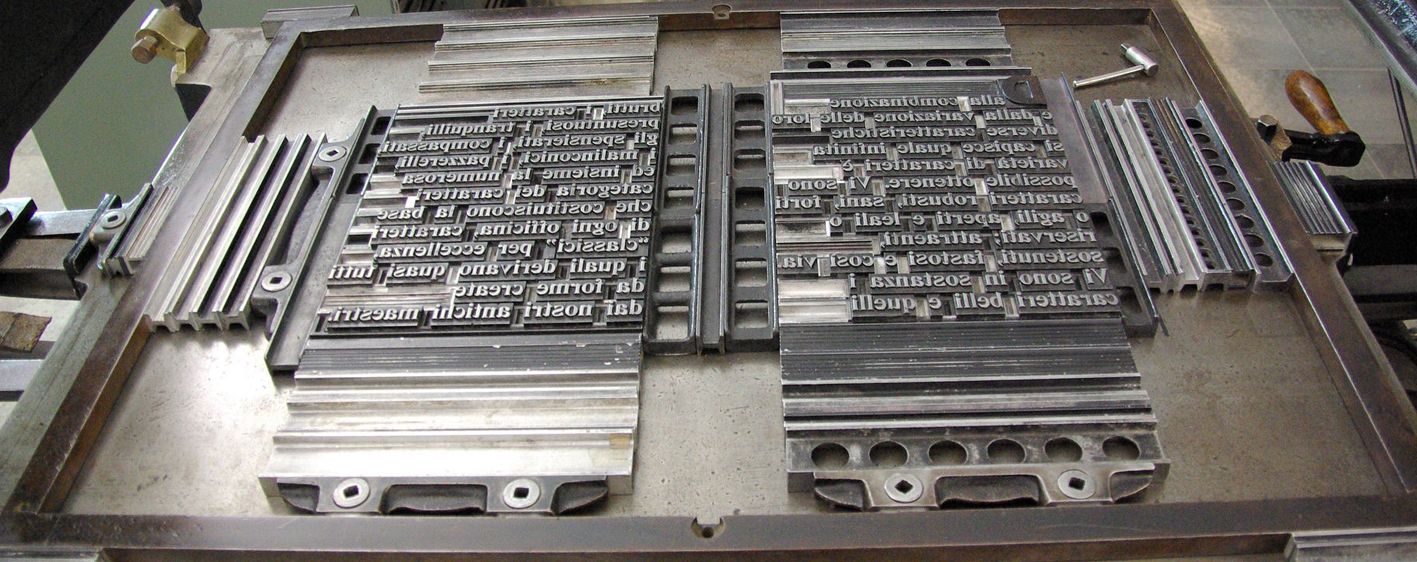
Central Printing Works was much more my style. I got to learn every part of the general printing trade there, from hand typesetting posters with wood block type on comp sticks two foot long, to machine minding and print finishing - all the way to guillotining and packing the finished product.
 They kept to their word too, investing in an IBM Selectric Typewriter, which had interchangeable golf ball heads for different type faces. I taught myself to type (after two night classes to get the basics, putting up with the giggles from all the females there ... my being one of only two males - the other being my colleague, who bore it as long as I did!) and got stuck into producing the programme for Kettering Town FC (my team!). It worked brilliantly and I learnt how to produce the programme pages, working the text round pencil lines I had made to accommodate pictures to be added at cold comp state (i.e. when laid down to artwork).
 It all had to be very accurate and left little scope for copy changes, because if you got something wrong, usually that meant starting all over again. When you're setting copy, say, 11pt on 11pt, there' no space to cut in that odd line or word ... and even if you could, you'd either put so much Spray Mount on it, the finished effort would look out of place, or use too little and it would drop off at the platemaking stage - making the whole process worthless!
By the time I left there, I was a fast and accurate typesetter, knew how to produce good, complex artwork, and was getting a feel for the new technology that - most of the unions (by this time I was a Head Office Branch Committee Official for the NGA in Bedford) were so deeply against. We all knew it had to come, but, as usual, instead of it being a way to make print more attractive and expansive, the bosses wanted to use it to cut jobs and deplete the power of the unions.
So, the only place I could really go was to the local newspaper, The Northamptonshire Evening Telegraph, or E.T. as it was better known. I joined there on a two year fixed contract as a typesetter. The Linotron equipment we were using was the "old" new technology, with only a 20-digit LCD character display to work from. So, if you put a code in, what you had just typed disappeared instantly. You really had to be accurate to be any good. I did get to use some of the proper new technology stuff - the Zenotron display advertising equipment and the bog basic pc-style text input keyboards and monitors - the latter of which I was using for setting small ads, BMD's, etc. This had a wider scope for pre-setting of function keys, so I set about putting larger, standard entry elements (such as funeral directors' details) and even smaller, frequenly used elements, e.g. ". Tel: 01536 " all into one keystroke, making output much faster.
Through all this time I embraced the technology whilst understanding that it would mean the loss of many jobs. The unions tried to ensure people were retrained in other areas, but the bosses didn't want to keep them, preferring to take on people at lower wages instead. We all knew how it would end, but it didn't stop many fighting it. However, as usual it was the "traitors" - those parts of the workforce with no class loyalty - who made deals with the bosses to secure their futures while shitting all over everyone else.
 At the E.T. this came in the form of the two main union reps, who did a deal with EMAP to start their own company to take over the E.T.'s typesetting needs, employing only their friends, enabling EMAP to close the origination side of the works down completely and make everyone else redundant. (Those traitors did get their comeuppance eventually, when EMAP did away with their services after their initial agreement came to an end. But by this time there were many trained men out of work, who lost newly-purchased houses - and also some, their lives.)
However, the unions did themselves, or rather, their members, no favours either. They had historically spent all their time trying to keep the wages of those on the national and local presses as high as possible - frequently drawing out all other members from general printing and other areas on strike in an attempt to further increase those already highly-paid staff's incomes. So, when the technology disputes came, after an initial furore, the support soon depleted. And who can blame the normally-paid staff? When they were fighting people like Eddie Shah, those self-same print workers on the national and local presses continued to draw their lucrative wage whilst allowing their employers to print lies and propaganda against their own union brothers.
In the middle of my two spells at the E.T., I was asked by a friend to come into his business (or rather his father and brother's) to amalgamate the three print works they had purchased into one big new set-up on the new industrial estate in the town. They wanted one big studio to run the lot and do work for outside companies. It could have worked. I did a lot of organisational work to make it happen, however, they gave me one person from the old companies to work with me who never had any intention of breaking sweat. He also made it quite clear he would not take orders from someone younger than himself. Ultimately, instead of simply doing little, he intentionally went out of his way to make problems for myself and everyone else - he refused to use the typesetting equipment they had purchased and spent his days doing paste jobs a ten-year-old could have surpassed! I had to go, so got a short term contract back at the E.T. before it was broken up by EMAP.
One funny aside to this - I won't mention the company's name, but the "father" figure who ran this new set-up used to be a chief executive at a snack-making company ... crisps to be exact. His offices were on a mezzanine floor above the shop floor and he famously asked one day why none of the machines were working. He told son No.2 that he wanted flashing lights installed on every machine, so he could see who was working and who was slacking. It was only dismissed when son No.1 pointed out that it could take one or two days to get a machine ready for a four-colour print run, then perhaps only a day to run the job, so even though machines weren't running, people were working getting it ready to run. He was bemused!
 Personally I'm surprised the twat didn't try to get his staff to wear lights on their heads that started flashing when they stopped moving for a second. I wouldn't have put it past him - especially after the case when he overheard someone whingeing that a colleague was having two shits a day during working hours when no-one else had more than one - and then got a lackey to start checking how many times a day every member of staff was answering the call of nature. How does it go? Un-be-fucking-lievable!
During my second stint at the E.T., personal circumstances were such that I needed a complete change. So I got a job in London, packed my bags, and like some Dick Whittington character, set my sights to the big smoke and went off to see what it could offer me …
continued in Print In London and the rest …